 China Beverage Machinery
LanguageEnglish
Complete Beverage Preparation
Beverage Processing Equipment: Systems and Selection
The processing system turns treated water and ingredients into a controlled beverage ready for filling. Its scope can include ingredient handling, dissolving, blending, filtration, heating, cooling, deaeration, homogenization, storage, CIP and hygienic transfer.
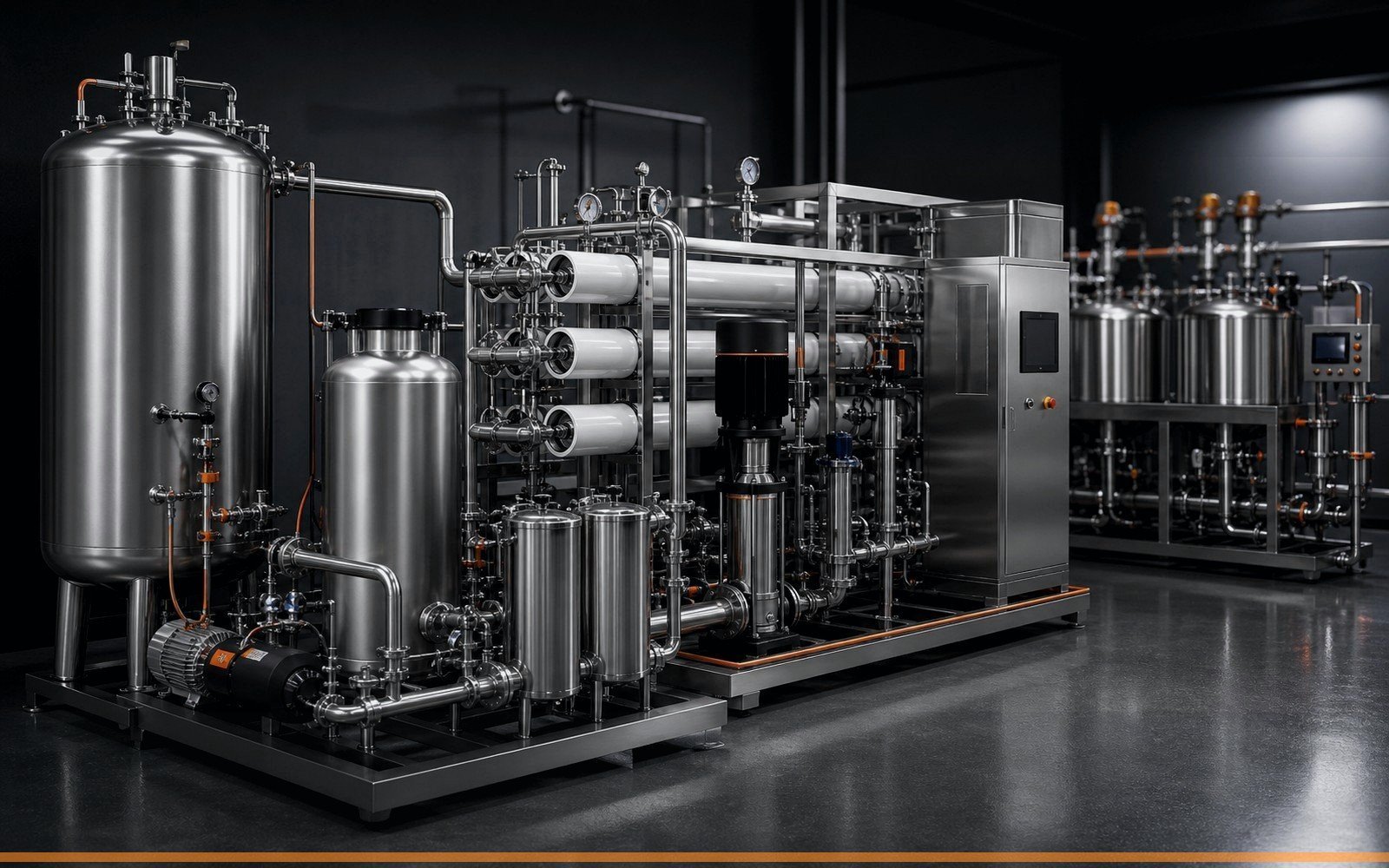
Choose beverage processing equipment by the product task
A beverage processing system prepares the liquid before it reaches the filler. Its equipment boundary differs from bottle handling, filling and final packing. Start with the ingredient and product tasks below, then define how each selected module connects to the next step.
| Product task | Equipment scope to review | Decision that must come first |
|---|---|---|
| Prepare treated water | Water treatment, treated-water storage and distribution. | Raw-water information, required product-water specification and simultaneous demand. |
| Prepare ingredients or syrup | Syrup room, ingredient handling and any required dissolving or filtration. | Ingredient form, addition sequence, concentration and preparation schedule. |
| Blend a finished beverage | Mixing and blending tanks, measurement and transfer, or a suitable inline arrangement. | Minimum batch, required uniformity, product behavior and downstream demand. |
| Control temperature or physical properties | Appropriate heating, cooling, deaeration, filtration or homogenization modules. | The product process defined by the responsible technologist; not every module belongs in every line. |
| Prepare a carbonated beverage | Carbonated beverage processing and the interface to pressure filling. | Product conditions, carbonation requirements and a compatible transfer and filler design. |
| Clean the connected process equipment | CIP supply and return, circuit routing and control interfaces. | Defined cleaning circuits, product residues, operating schedule and validation responsibility. |
These links describe equipment categories for project review. Actual supply, configuration and performance are established in the project quotation and acceptance documents.
Define the handoff from processing to filling
Use one interface record agreed by both sides of the connection. For an existing filler, attach its verified requirements; for a new filler, resolve them before freezing the process-room design.
| Interface field | Record this | Supplier response to request |
|---|---|---|
| Product state | Recipe family, relevant viscosity or particles, required temperature and any sensitive characteristics. | Inlet/outlet limits, assumptions and unresolved compatibility checks. |
| Flow basis | Normal demand, turndown, start/stop behavior and the required production schedule. | Operating envelope and response when the downstream machine slows or stops. |
| Buffer and transfer | Working volume, permitted holding conditions, pump and pipe boundary. | The arrangement and control responsibility; separate storage from validated product holding. |
| Signals and controls | Ready, run, stop, low-level and fault states that affect the connection. | An agreed signal list and test sequence for abnormal conditions. |
| Cleaning boundary | Equipment and routes covered by each party, with the return endpoint. | Compatible cleaning interfaces, isolation and test/validation responsibilities. |
| Acceptance evidence | Reference product, agreed conditions, measurement points and record owner. | A test plan separating interface performance from the plant’s product and hygiene validation. |
Technical context and project evidence
Industry process systems are commonly presented as connected modules. The Krones SyPro overview is one example of ingredient preparation linked to final mixing; Tetra Pak’s blending overview describes batch and continuous approaches. These references explain general alternatives, not an affiliation or a performance claim for our equipment.
Use the selection map above to prepare the inquiry and the detailed sections below to review scope, utilities and handover. China Beverage Machinery is operated by Allot Tech (Suzhou) Co., Ltd. for machinery sourcing and project coordination. Content updated 29 September 2026.
What this equipment must do inside a complete line
A complete line proposal should define the processing boundary before the filler is selected. Product formula, batch size, shelf-life route, ingredient form and changeover schedule affect tank volume, heat treatment, piping, valve automation and cleaning circuits.
Buyers should separate confirmed requirements from options. For example, pulp handling, homogenization, deaeration or aseptic storage may be necessary for one recipe and unnecessary for another. This prevents both missing equipment and an oversized process room.
Batch preparation
Ingredients are measured and blended in defined batches, with tank scheduling coordinated to filler demand and cleaning time.
Continuous treatment
Some heating, cooling, filtration or carbonation steps can operate continuously when upstream and downstream flows are balanced.
Hybrid process room
Batch mixing can feed continuous thermal treatment and filling through buffer tanks sized for the real production schedule.
Modules and interfaces to define before quotation
A useful proposal should state what is included, what is optional and where another supplier or the buyer takes responsibility.
Raw material receiving
Define powders, liquid concentrates, sugar, acids, flavors and other ingredients, including package size, handling method and storage conditions.
Water treatment interface
State raw-water analysis, treated-water quality target, recovery assumptions and peak demand from processing, rinsing, CIP and utilities.
Mixing and storage tanks
Tank count and working volume depend on recipe sequence, batch size, filler demand, cleaning time and whether products share equipment.
Thermal and physical process
Pasteurization, UHT, cooling, filtration, deaeration and homogenization should be selected from the product and shelf-life process defined by the buyer’s technologist.
Hygienic transfer
Pipe routes, valve manifolds, pumps, instrumentation and buffer strategy must keep the product condition stable between processing and filling.
CIP integration
Cleaning circuits should be divided by equipment soil, temperature, chemical recovery, route length and production schedule rather than by tank count alone.
Information that changes equipment selection
Send engineering inputs in a structured format so suppliers compare the same duty instead of quoting different assumptions.
| Decision area | What to provide | Why it matters |
|---|---|---|
| Formula and ingredients | Recipe family, soluble solids, acidity, viscosity, pulp or particles and ingredient form. | Defines mixing duty, filtration, heat exchange and cleanability. |
| Batch plan | Batch volume, batches per shift, product sequence and expected changeovers. | Defines tank count, working volume and scheduling margin. |
| Shelf-life route | Cold chain, hot fill, tunnel pasteurization, ultra-clean or aseptic target. | Defines treatment, hygienic zone and filler interface. |
| Package and filler | Container material, filling temperature and filler demand. | Defines buffer, cooling and transfer conditions. |
| Utilities | Steam or hot water, chilled water, power, air, water and drainage. | Defines heat recovery and utility equipment boundary. |
| Automation | Recipe control, dosing confirmation, batch records, alarms and traceability. | Defines instrumentation and PLC/HMI scope. |
Decisions buyers should resolve with the supplier
Process authority and equipment supplier
The buyer should define the validated product process with qualified food technologists. Equipment selection then implements that process without inventing shelf-life claims.
Tank volume is not just hourly output
Tank sizing must include batch preparation time, transfer, cleaning, product sequence and filler interruptions. A simple hourly multiplication can create shortages or excess hold time.
Shared equipment creates changeover work
Running multiple allergens, colors, flavors or product families through common tanks and pipes requires a documented cleaning and segregation plan.
Utility peaks matter
Heating, cooling and CIP can create short peak loads that are higher than average production consumption. The RFQ should identify simultaneous users and recovery assumptions.
Send these RFQ inputs
- Complete recipe families and ingredient forms
- Target batch sizes and production schedule
- Required filling and product treatment conditions
- Container and filler capacity by SKU
- Available steam, hot water, chilled water and compressed air
- Cleaning chemicals, recovery preference and drainage limits
- Automation, batch reporting and traceability requirements
- Process room dimensions and future expansion plan
Verify these points before handover
- Tank working volume and usable heel verified
- Dosing, mixing and transfer sequences demonstrated
- Temperature and flow instruments checked against references
- Valve routing and interlocks tested for incorrect paths
- CIP routes, return conditions and drain points documented
- P&IDs, equipment list, manuals and recipe backup handed over
Keep the proposal comparable
Ask every supplier to identify equipment scope, utilities, buyer-supplied items, reference packages, controls interfaces, documentation, training, spare parts, installation boundary and acceptance method.
Final configuration depends on confirmed product, container, output, factory and regulatory requirements.
Frequently asked questions
What is included in a beverage processing system?
The scope can include water treatment interfaces, ingredient preparation, syrup dissolving, blending tanks, filtration, heat treatment, cooling, deaeration, homogenization, storage, transfer and CIP. The exact scope follows the recipe and shelf-life process.
How are processing tanks sized?
Tank sizing uses batch volume, preparation and transfer time, filler demand, cleaning duration, product sequence and operating hours. Required gross volume and working volume should be stated separately.
Can one process room make several beverages?
Yes when the product matrix, ingredient compatibility, cleaning validation, valve routing and scheduling are designed for shared use. Some products may need dedicated circuits or tanks.
Does the equipment supplier determine product shelf life?
Shelf life depends on formula, validated processing, packaging, hygiene and storage. Buyers should use qualified food technologists and laboratory validation; the equipment proposal should support the confirmed process.
Continue building the complete line scope
Send product, package, capacity and factory information
Include beverage type, container drawings, target saleable output, utilities, factory dimensions, destination country and purchase timeline. We will organize the equipment scope for quotation.
Continue the technical comparison
Use the most relevant planning and service pages instead of treating each machine as an isolated purchase.
Sensitive beverage processing paths
Use the broad process-room scope with product-specific requirements for extraction, allergens, particles, thermal treatment and hygienic filling.