 China Beverage Machinery
LanguageEnglish
Complete water bottling project
Bottled Water Production Line: PET Equipment and Capacity
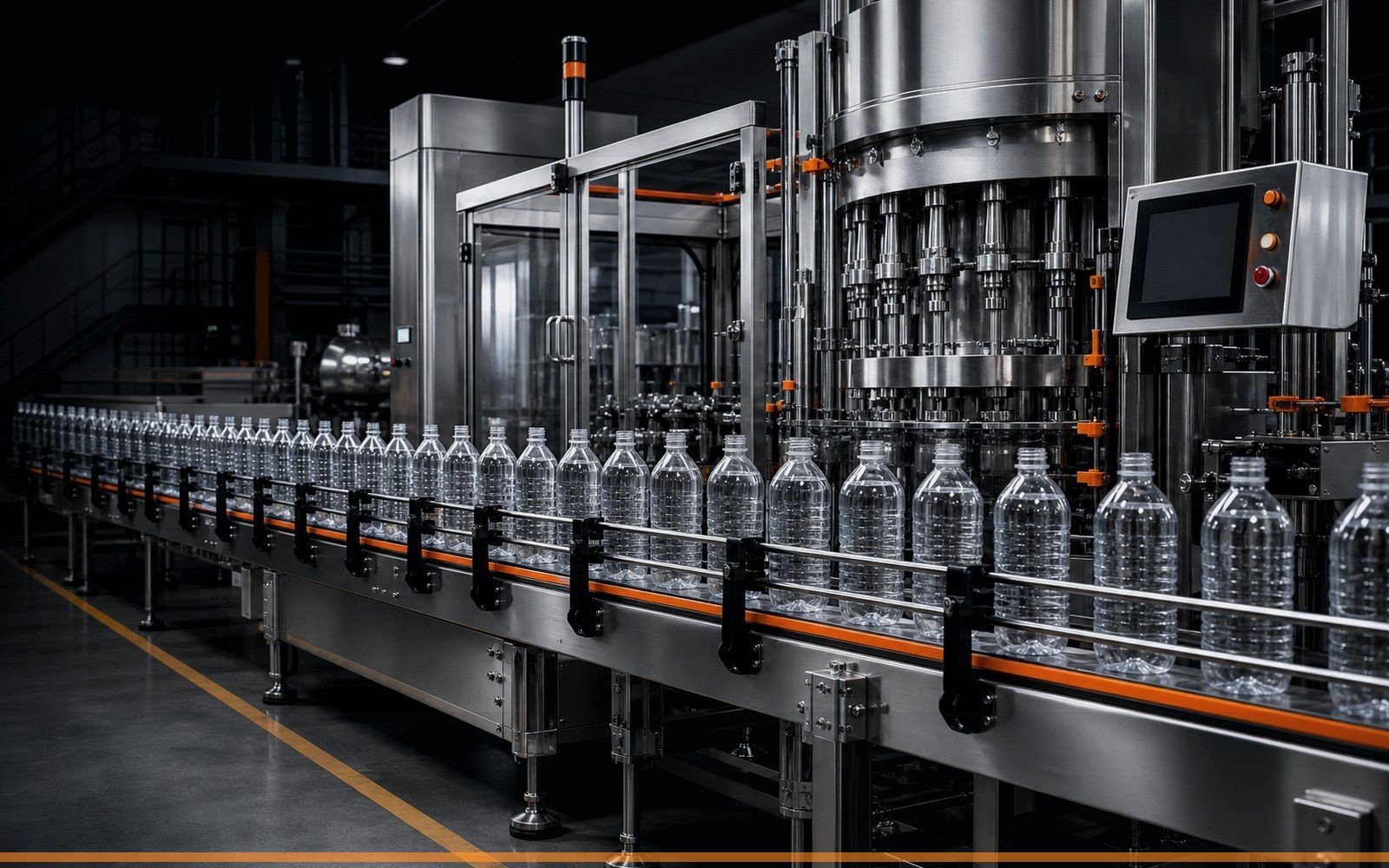
A PET bottled water production line connects approved water treatment and bottle supply to rinsing, filling, capping, labeling and final packing. Choose the bottle-supply route first, then balance the connected equipment against the required saleable bottles and packs per shift.
Choose the bottle-supply configuration
| Configuration | Equipment arrangement | Best reason to evaluate it |
|---|---|---|
| Purchased empty bottles | Receiving and protected storage, bottle feeding, agreed container preparation, filler-capper and downstream equipment. | Avoid on-site blowing when delivered-bottle supply, storage and recurring freight are workable. |
| Standalone PET blowing | Preform feeding, heating/blowing, molds, air and cooling services, then transfer to the filling section. | Produce approved bottles on site while retaining a defined transfer and buffer arrangement. |
| Integrated blowing and filling | A coordinated blow-fill-cap arrangement with matched formats, utilities and controls. | Assess direct transfer and a compact process arrangement against format flexibility, maintenance and stop recovery. |
| Expansion of an existing line | Retain proven modules and replace or supplement the actual bottleneck. | Increase accepted output when existing treatment, utilities, conveyors and packing can support the change. |
These are configurations to evaluate, not fixed packages. Compare delivered bottles against preforms, molds, blowing utilities, staffing and maintenance over the same production volume. A blower-only price does not represent the complete bottle-supply cost.
Build the water-to-pack process around defined interfaces
The product path is source water → selected treatment → approved storage and transfer → filling. The packaging path is bottles or preforms → container preparation → filling and closing → inspection/coding → labeling → packing → agreed pallet or warehouse transfer. Cleaning connects to the relevant equipment through its own defined circuit.
| Line section | Selection basis | Scope to make explicit |
|---|---|---|
| Water treatment | Source-water analysis, finished-water specification and plant water balance. | Treatment stages, tanks, transfer pumps, sampling points and cleaning requirements. |
| Bottle and cap supply | Approved drawings, material suppliers, bottle dimensions and neck/closure combination. | Feeding equipment, molds or change parts, container preparation and cap handling. |
| Filling and closing | Reference water, package, fill quantity and required accepted output. | Filler/capper configuration, transfer interfaces and fill/closure checks. |
| Labeling and packing | Label method, code location, bottles per pack and delivery presentation. | Drying where needed, labeling, coding, inspection, film/carton/tray scope and conveyors. |
Water treatment is not a universal sequence of filters and RO. For mineral or spring-water products, have the intended composition and applicable product requirements reviewed before selecting treatment. This page concerns still PET water; sparkling water and returnable large bottles need their own process and handling review.
Work backward from saleable output
Illustrative planning example: the target is 40,000 accepted 500 mL bottles in 8 scheduled production hours, after separately planned cleaning and format changes. If the combined factor for remaining stops, speed loss and rejects is 80%, the reference nominal rate is 40,000 ÷ (8 × 0.80) = 6,250 BPH. Do not deduct the same losses again.
At that nominal reference rate, the contained water flow is 6,250 × 0.5 = 3,125 L/h. At 12 bottles per pack, the corresponding rate is about 8.68 packs/minute. These are calculation bases, not machine guarantees or complete treatment and packer specifications.
- Request output for every launch bottle, not a single capacity range that hides a slower large format.
- Size treatment against its operating schedule, storage strategy and all relevant water uses; product water alone excludes washing and treatment losses.
- Review accepted bottle supply, cap feed and accumulation so the filler is neither starved nor blocked.
- Check labeling and packing using the actual label and pack pattern, including short-stop recovery.
- Record the reference SKU, production-time definition, loss assumptions and test duration beside the promised line output.
Release a bottle, closure and pack matrix
List bottle volume, body dimensions, height, neck finish, closure, label and final pack for each SKU. Include drawings and representative samples. A shared volume does not establish compatibility, and a new neck finish can affect blowing, transfer and capping together.
For lightweight bottles, trial conveying, filling, closure application and packing as a connected sequence. Inspect bottle stability and the finished pack rather than accepting the empty bottle alone. Keep unapproved future formats separately priced until tooling and performance are reviewed.
For a retrofit, record the existing conveyor height, direction, transfer point, controls, available space and actual operating rate. Resolve ownership of the interconnecting conveyor and line signals before ordering the new machine.
Compare complete supply and acceptance conditions
Separate equipment, molds/change parts, utilities, site installation, training and spare parts in the proposal. State who provides compressors, cooling, electrical distribution, piping, drainage and lifting or unloading. Include consumables and production materials required for testing.
Accept the coordinated line against agreed water and packaging specifications, sustained accepted output, fill and closure checks, coding, label appearance and final packs. Include controlled stop/restart and one agreed format change. Record any factory-test substitutions and the remaining site-test items before shipment.
Frequently asked questions
Is bottle blowing required for a water bottling line?
No. The line can receive purchased bottles when their supply, quality, storage and feeding arrangement are suitable. On-site blowing adds preform handling, molds, air, cooling and integration requirements.
Does a 6,250 BPH filler guarantee 40,000 bottles per day?
No. That planning example assumes 8 defined production hours and an 80% combined output factor. The complete line, package, utilities and agreed losses must support the target.
Is RO necessary for every bottled water project?
No. Treatment should follow the source-water analysis and required finished-water specification. The intended product composition and applicable requirements also need review.
Continue your project planning
Planning guide from Allot Tech (Suzhou) Co., Ltd. Updated 16 September 2026.
Choose a Water Line by Planned Capacity
Capacity must be tied to a reference bottle, operating schedule and end-of-line pack. Start with the closest planning guide, then validate the complete configuration.