 China Beverage Machinery
LanguageEnglish
Equipment module guide
Beverage Mixing Tanks: Batch Size, Agitation and Blending
Beverage mixing tanks combine ingredients in controlled batches before treatment, storage or filling. Select them by minimum and maximum working volume, ingredient behavior, mixing duty and the production schedule. Vessel capacity alone does not describe what the tank can reliably mix.
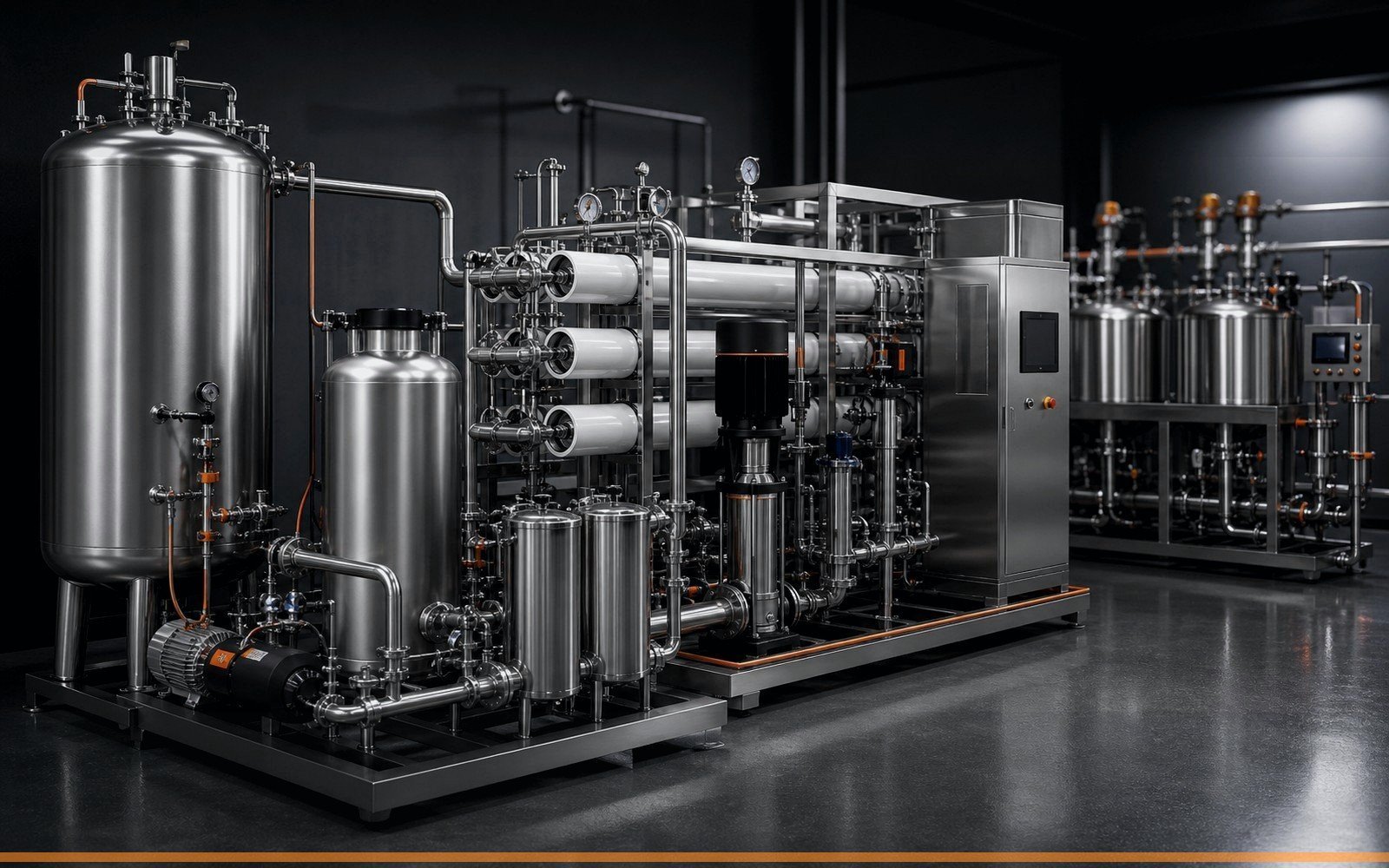
Which mixing duty does your beverage need?
Start with a recipe family and its most demanding operating condition. A clear drink made from soluble liquids, a powder-based beverage and a product with visible particles can need different ingredient addition and mixing arrangements. Describe what must change in the product, as well as what must be preserved.
| Duty to review | Information that changes the selection | Evidence to request |
|---|---|---|
| Liquid blending | Ingredient proportions, viscosity at mixing temperature, density differences and addition order. | A batch procedure and a sampling plan showing where and when uniformity will be checked. |
| Powder addition or dissolving | Powder form, wetting behavior, concentration, temperature limits and acceptable preparation time. | An ingredient trial that records addition time, remaining lumps, air entrainment and the agreed endpoint. |
| Suspending pulp or particles | Particle dimensions, settling tendency and whether particles may be damaged. | Trials at low and high working levels, including a hold period and transfer through the selected pump. |
| Preparing an emulsion or dispersion | Required product characteristics and sensitivity to heat or shear. | A process review establishing whether tank agitation is enough or a separate mixing/homogenizing step is needed. |
| Holding an already prepared beverage | Permitted hold conditions, settling, foam and supply demand from the next machine. | A holding and transfer test; do not assume a buffer tank can perform the original preparation duty. |
An agitator, recirculation loop and high-shear device are different tools. Ask the supplier to explain the duty and operating limits of the proposed arrangement instead of selecting the highest motor rating.
How do you choose working volume and tank count?
Specify minimum usable batch, maximum working batch and gross vessel volume separately. The working limit must account for the actual process, including ingredient addition, circulation and foam. The minimum limit matters when a launch recipe or short run uses much less product than the main SKU.
| Volume or time | Write this in the RFQ | What it prevents |
|---|---|---|
| Gross volume | Total geometric vessel volume, stated separately from usable product volume. | Treating the catalogue vessel size as a guaranteed batch size. |
| Working volume | Minimum and maximum usable product volume for each recipe and mixing duty. | An agitator or instrument operating outside its proven range. |
| Preparation cycle | Charging, mixing, sampling, any waiting, transfer and the time until the vessel can start another batch. | Sizing the system from mixing time alone. |
| Cleaning and changeover | The relevant product sequence and the actual time when a tank or shared path is unavailable. | Counting unavailable tank time as production time. |
| Downstream demand | Required liquid flow, permitted interruption and conditions at the treatment or filler inlet. | A full tank that cannot maintain the needed supply conditions. |
Illustrative planning check: assume a downstream machine needs 3,000 L/h and a 2,000 L working batch is released for transfer. That batch represents 40 minutes of downstream consumption: 2,000 ÷ 3,000 × 60. If preparing the next batch takes 50 minutes, one preparation stream cannot sustain that demand by itself. A buffer may cover a short gap but does not remove a continuing average shortfall.
This is a scheduling example, not a recommended tank size or a machine performance claim. Compare the full time diagram, required product hold conditions, parallel preparation options and transfer capacity before fixing the arrangement.
Compare the tank configuration before requesting a price
| Choice | Useful question | Quotation boundary |
|---|---|---|
| Agitation and recirculation | Can the required product be prepared at both working-volume limits without unacceptable foam, settling or damage? | Agitator, speed control, pump, pipework, seals and the stated test method. |
| Ingredient measurement | How will small and large additions be checked against the same recipe? | Load cells or meters, minor-ingredient method, calibration and batch record. |
| Heating or cooling | Is temperature control required during preparation, holding or both? | Jacket or external exchanger, temperature limits, utility duty and controls. |
| Addition points and access | How are bags, drums or liquid supplies connected in daily operation? | Platform, access, handling aids, dust or splash controls and items provided by the buyer. |
| Product-contact design | Which materials, seals, surface details and cleaning access are appropriate for the agreed product? | A material and component schedule; any certification must be identified and supported by the actual document. |
| Automation | Which steps require confirmation, permissions, alarms or an electronic record? | Recipe sequence, instrument list, signal interfaces, data export and backup delivery. |
A jacketed tank, an insulated tank and a pressure-rated vessel are not interchangeable descriptions. State the required operating conditions and ask for the applicable design basis; do not infer them from the word stainless.
Batch tanks, inline blending or a hybrid arrangement?
Batch preparation is worth reviewing when ingredients need a defined sequence, a preparation period or a batch release decision. Inline blending is worth reviewing when compatible ingredient streams can be supplied and controlled continuously. A hybrid can prepare a premix in a tank before a continuous finishing step.
Compare changeover losses, recipe flexibility, ingredient measurement, staffing, space and the effect of a filler stop. Record what happens at startup and shutdown and where any out-of-spec mixture goes. An apparently smaller equipment list may still need additional ingredient conditioning, storage or product recovery.
For the broader interfaces, use the beverage processing system guide. A dedicated syrup-room review is useful when dissolving and concentrate preparation sit upstream of final blending.
Prepare a useful mixing trial and handover record
- Identify the product, ingredient lot, recipe revision and test batch volume. Use an agreed substitute only where it can represent the behavior being tested.
- Record the addition order, mixing settings, time and relevant product temperature. Identify the measurement method before the trial starts.
- Sample at agreed points and times; define acceptable uniformity and any limits on foam, particles or undissolved material with the buyer’s process team.
- Demonstrate transfer, minimum working level, stop/restart response, drainability and the defined cleaning connections.
- Record deviations, actions and retest responsibility. Include drawings, instrument calibration records, approved parameters and spare-parts identification in the handover.
For an existing line, include the actual pipe connections, elevations, control signals, shutdown window and available utilities. A vessel that physically fits the room can still be unsuitable for the process or cleaning route.
Frequently asked questions
Is a mixing tank the same as a storage tank?
No. A mixing tank is selected for an ingredient preparation duty, while a storage or buffer tank may only need to hold an already prepared product. Some vessels can serve both roles, but the mixing range, holding conditions and cleaning method must be confirmed.
Can one beverage mixing tank handle every recipe?
Only if the actual recipes fit its tested operating envelope. Minimum batch size, viscosity, particles, foam, ingredient addition and cleaning between products can limit shared use. Request representative trials rather than a universal compatibility promise.
Does a bigger tank increase line output?
Not necessarily. Output depends on the complete preparation, transfer, cleaning and downstream schedule. A larger batch can increase available volume while also increasing preparation or holding time.
What should I send for a mixing tank quotation?
Send recipe families and ingredient forms, minimum and maximum working batches, preparation and filling schedules, product conditions, cleaning requirements, utilities, factory layout and the required test record. Mark unconfirmed inputs explicitly.
Technical references and evidence scope
- Tetra Pak: batch and continuous blending approaches — Background on alternative blending arrangements; not evidence of our equipment performance.
- Krones SyPro: modular ingredient preparation — Industry example of separating ingredient preparation and final mixing duties.
These sources provide general industry context. They do not identify a partnership, certify our equipment or establish the specifications of a future quotation. The decision tables and labeled planning examples on this page are buyer preparation aids.
Continue the same project brief
- Processing system and filler interfaces
- CIP equipment selection
- Line integration support
- Factory acceptance test checklist
- Prepare a comparable RFQ
Published by Allot Tech (Suzhou) Co., Ltd., operator of China Beverage Machinery. Content updated 29 September 2026.