 China Beverage Machinery
LanguageEnglish
Upstream water quality
Beverage Water Treatment System: Flow, RO and Storage
A beverage water treatment system must deliver the required quality and flow at each point of use. Begin with a current raw-water analysis and a demand schedule for product water, rinsing, cleaning and other users; select treatment steps only after those requirements are defined.
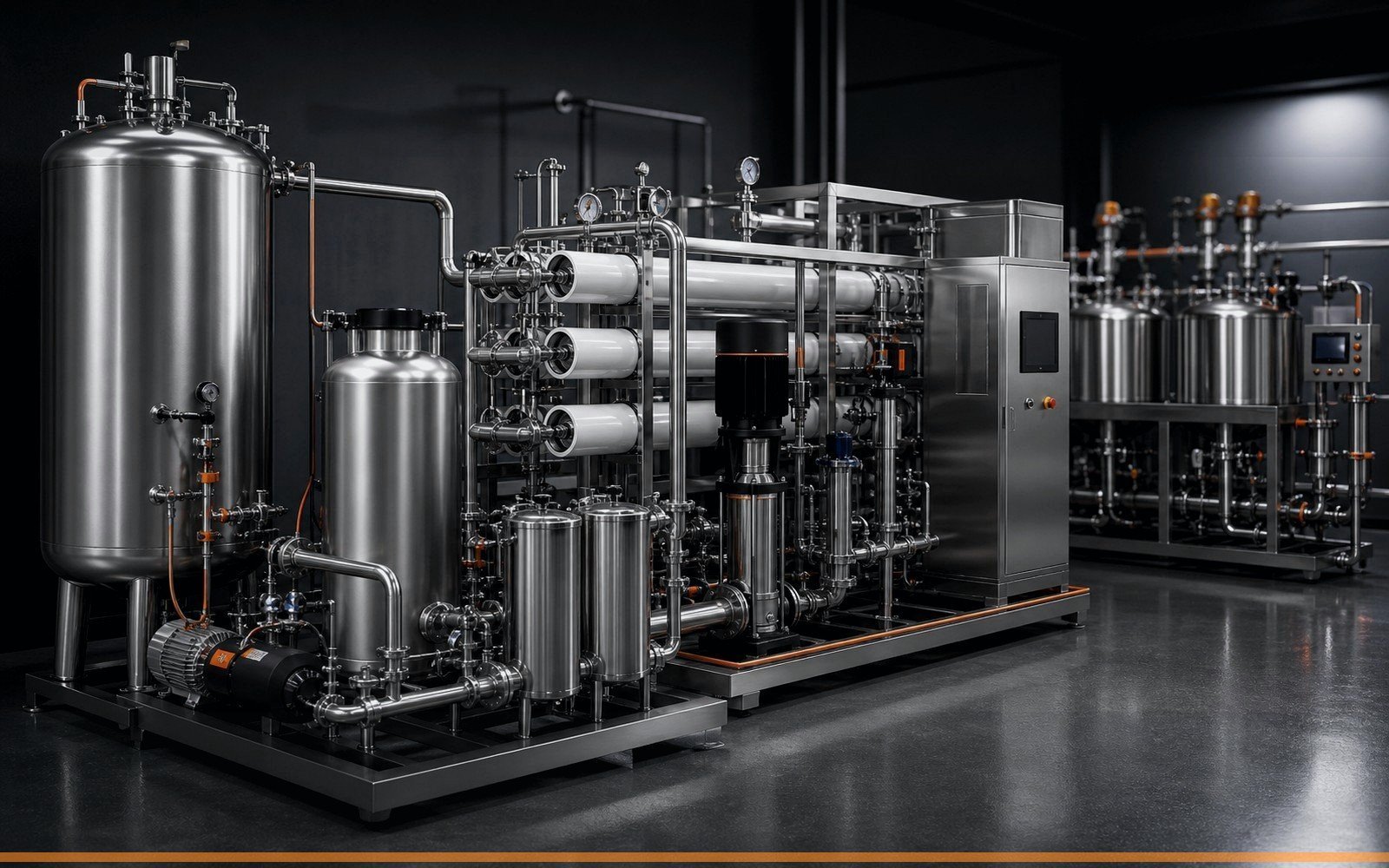
Define water quality before selecting the process
The same treatment train is not suitable for every source or beverage. Municipal, well and surface water can present different concerns and seasonal variation. Product water, bottle rinse and utility water can also have different requirements. Send the source description, laboratory results and intended use together.
| Design input | Effect on the proposal |
|---|---|
| Physical and chemical analysis | Identifies the parameters the proposed filtration, conditioning or membrane process must address. |
| Microbiological analysis and hygiene requirements | Informs disinfection, storage, distribution, sampling and the required validation plan. |
| Source temperature, pressure and seasonal variation | Affects feed conditions and the basis for equipment output and performance. |
| Finished-water requirements | Defines the intended water composition and quality rather than assuming maximum removal is always desirable. |
| Local destination requirements | Identifies the product and installation requirements to be confirmed by the responsible buyer and specialists. |
An RO unit may be appropriate for some sources; it is not automatically necessary for every bottled-water or beverage project. Ask the supplier to explain each proposed stage and to state the feed-water limits under which it is sized.
Separate product flow, service demand and RO feed
Start with the filling duty, then add the other simultaneous treated-water users. Work in liters per hour or cubic meters per hour throughout the balance. Do not compare a raw-water feed rating with a treated-water delivery rating.
| Illustrative calculation | Result |
|---|---|
| 10,000 bottles/hour × 0.5 liter/bottle | 5,000 liters/hour = 5.0 m³/hour of filled product |
| Add an assumed 1.0 m³/hour of simultaneous rinse and other treated-water demand | 6.0 m³/hour required at the treatment/distribution boundary |
| If the proposed RO recovery is assumed to be 75%: 6.0 ÷ 0.75 | 8.0 m³/hour RO feed and 2.0 m³/hour concentrate |
The 1.0 m³/hour service demand and 75% recovery are examples only. Actual demand and achievable recovery require supplier calculations from the water analysis and operating conditions. Add upstream backwash and other raw-water uses separately; concentrate is not the entire plant wastewater flow.
Compare peak simultaneous flow with daily volume. A buffer tank can cover a defined shortfall for a limited time, but its usable volume, refill schedule and hygiene arrangements must be established. A large tank does not compensate for insufficient daily treatment capacity.
Specify the system beyond the treatment skid
| Boundary | What the quotation should state |
|---|---|
| Pretreatment | Proposed filters or conditioning, feed-water limits, backwash demand and maintenance access. |
| Membrane system, if required | Net treated output at stated feed conditions, recovery basis, monitoring, cleaning and concentrate connection. |
| Storage and distribution | Usable tank volume, construction, venting, recirculation, sanitation, pumps and point-of-use flow/pressure. |
| Disinfection, if required | Selected technology, operating limits, monitoring and responsibility for validation at the intended use. |
| Controls and services | Sampling locations, alarms, permissive signals, power, chemicals, drainage and local installation boundary. |
UV and ozone are different process options, not interchangeable labels on a quotation. The responsible design must account for the water characteristics, equipment conditions and intended downstream process. Avoid a performance promise based only on the presence of a disinfection device.
Agree quality and capacity evidence before purchase
The acceptance plan should state who samples, where samples are taken, which methods and laboratory are used, and the operating conditions for the test. Pair quality results with measured flow and pressure at agreed locations. A skid output test alone does not prove delivery at the filler.
- Approve the process flow, water balance and feed-water design limits.
- Document materials, key components, instruments and the cleaning or sanitation procedure.
- Check treated flow, recovery where applicable, pressure and alarms at the agreed test conditions.
- Record sampling results from the specified points using the agreed procedures.
- Hand over operating limits, consumable schedules, maintenance instructions and responsibility for ongoing monitoring.
Frequently asked questions
Can water treatment be quoted without a laboratory report?
A preliminary scope can be discussed, but final equipment selection and performance conditions should use a current raw-water analysis and the required point-of-use quality.
Does a 5 m³/hour RO unit supply a 10,000 BPH water line?
At 500 ml, the filled product alone uses 5 m³/hour at that speed. Rinsing, cleaning, losses and other simultaneous users require a separate water balance, so the nominal RO rating alone is insufficient.
Should all plant water pass through RO?
Not automatically. Separate the uses and their required qualities, then evaluate treatment and distribution routes against the source analysis and project requirements.
Prepare your equipment scope
Send the approved product and package information, required accepted output, factory conditions, destination and purchasing timeline. Mark provisional specifications clearly so that the quotation can identify assumptions and alternatives.
Planning guide from Allot Tech (Suzhou) Co., Ltd. Updated 14 September 2026.
Size Treatment From the Complete Water Balance
Use raw-water evidence, product demand, cleaning, rinsing, recovery and storage to prepare the treatment RFQ.