 China Beverage Machinery
LanguageEnglish
Hot fill and non-carbonated beverages
Juice and Tea Filling Line: Processing, Filling and CIP
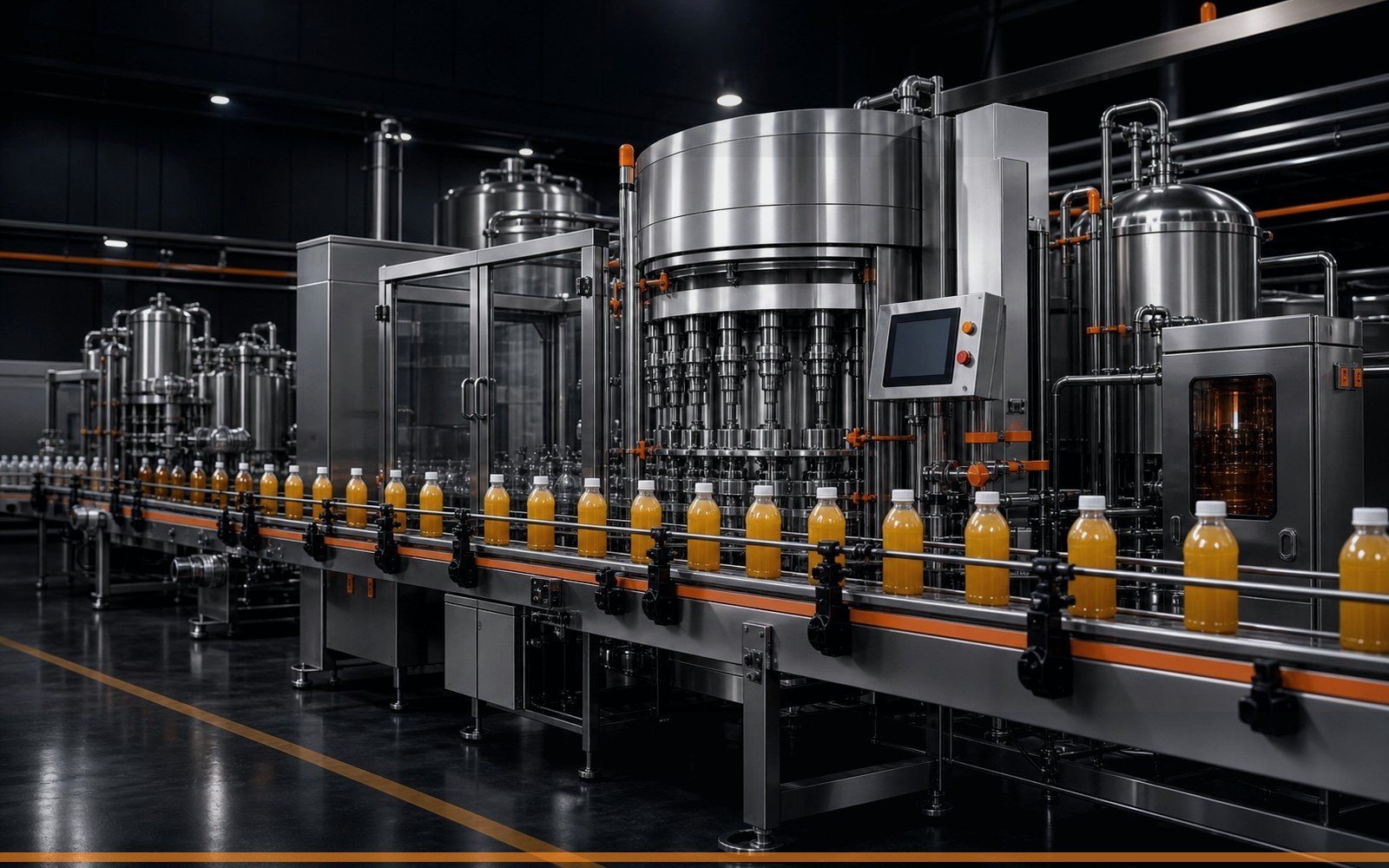
A juice and tea filling line combines beverage preparation, the selected preservation process, suitable filling and closing, and downstream handling. Clear tea, clarified juice and a pulpy beverage can require different product circuits even when they use the same bottle.
Start with the product family and its handling needs
| Product characteristic | Equipment consequence | Input needed for selection |
|---|---|---|
| Clear tea or clarified juice | Extraction or ingredient preparation, blending and any specified filtration must feed a consistent product to the filler. | Recipe family, preparation method, product specification and batch size. |
| Pulp, fibers or fruit pieces | Tanks, pumps, transfer passages and filling valves need a coordinated particle-handling review. | Particle dimensions and concentration, viscosity, settling behavior and representative product. |
| Multiple recipes | Cleaning, product recovery, tank availability and recipe control affect the production schedule. | Named product transitions, campaign sizes, ingredient differences and release checks. |
| Temperature-sensitive product or package | Preservation route and packaging must be selected together. | Intended distribution, shelf-life objective, package drawings and the validated process requirements. |
Do not select a larger filling opening in isolation for pulpy products. Product suspension, transfer and distribution between filling positions also affect consistency. Ask for trials that check both fill quantity and the agreed distribution of particles.
Match preservation, filling and packaging
Choose the preservation process with the responsible product and process specialists before committing to a filler. Hot filling, hygienic cold filling and aseptic processing describe different requirements; one does not automatically substitute for another.
| Route under evaluation | What must be coordinated |
|---|---|
| Specified hot-fill process | Product treatment and transfer, filling conditions, approved heat-compatible bottle and closure, any required post-fill treatment and cooling. |
| Refrigerated or other defined cold-fill process | Product treatment, hygienic filling/closing, the required distribution conditions and validation of the complete preservation plan. |
| Aseptic process | A validated system covering product, package, sterile interfaces and the filling environment; review as a distinct engineering scope. |
No single temperature, holding time or shelf-life claim applies to every juice or tea. Use approved product-specific process conditions in the quotation and acceptance plan. A cold filler or stainless-steel construction alone does not establish aseptic capability.
Balance preparation batches with filler demand
Illustrative flow calculation: 5,000 accepted 350 mL bottles per hour contain 1,750 L/h of beverage. A 2,000 L usable batch would supply about 68.6 minutes at that rate before additional product losses. Preparation, treatment, transfer, tank turnaround and cleaning must fit the operating schedule; nominal tank volume is not necessarily usable batch volume.
A second tank can change scheduling flexibility, but it does not automatically solve a preparation or treatment bottleneck. Draw a timeline showing when each vessel is preparing, supplying, emptying, cleaning and available for the next batch. Confirm how the filler responds if supply stops or the downstream packer blocks.
- State usable batch volume, preparation time and product-transfer conditions for each recipe.
- Request process throughput and filling output under the same product and package conditions.
- Identify permissible product-holding conditions and the action after an extended interruption in the approved process.
- Define how startup, recovered product, rejects and changeover losses enter the production estimate.
- Check cooling, drying, coding and labeling at the actual bottle condition leaving the process.
Show CIP as a connected cleaning circuit
Cleaning-in-place is a service to suitable product-contact circuits, not a product step after bottle cooling. Show the cleaning supply and return separately from the beverage-flow diagram. Map which tanks, heat exchangers, transfer lines and filler circuits are covered, and which items require a different cleaning method.
| Cleaning question | Required scope evidence |
|---|---|
| Circuit coverage | A circuit list and flow diagram, including returns, bypasses and any manually cleaned components. |
| Process requirements | Approved cleaning conditions, measurement points, monitoring and release criteria for the intended products. |
| Resource demand | Water, heating, chemicals, return capacity and drainage under the defined cleaning schedule. |
| Recipe change | Tasks, product recovery, cleaning and checks between two named products, with an agreed time basis. |
Cleaning effectiveness must be validated for the actual equipment and product. Request the required records and operator instructions rather than adopting a generic concentration or cleaning duration from a sales page.
Test the recipe and package together
Define the recipe/sample revision, approved bottle and closure, process conditions, trial duration and pass criteria. Evaluate accepted output, fill consistency, closure quality, bottle condition after cooling and the finished label and pack. For products containing particles, include the agreed particle-distribution checks.
A factory demonstration with water can prove selected mechanical functions but cannot prove the intended beverage process or shelf life. Identify what it does establish and assign remaining product/process validation and site acceptance to named responsible parties. Request operating settings, process and cleaning diagrams, format parts, inspection records and spare-parts information at handover.
Frequently asked questions
Can one line produce clear tea and pulpy juice?
Possibly, if the complete preparation, transfer and filling system supports both products. Confirm particle handling, cleaning transitions, package compatibility and output for the named recipes.
Is CIP performed after each filled bottle is cooled?
No. CIP cleans defined product-contact equipment and piping through its cleaning circuits according to an approved schedule. It is separate from the sequence followed by saleable bottles.
Can a water trial prove juice shelf life?
No. A water trial may demonstrate mechanical functions. Product and shelf-life validation requires the actual approved process, beverage, package and distribution assumptions.
Continue your project planning
Planning guide from Allot Tech (Suzhou) Co., Ltd. Updated 16 September 2026.