 China Beverage Machinery
LanguageEnglish
Bottle supply planning
PET Bottle Blowing Machine: Molds, Air and Line Integration
Choose a PET bottle blowing machine around approved bottles and preforms, the required output for each format, and the utilities available at your factory. A blower quotation is incomplete until molds, air treatment, cooling and transfer to the filler are defined.
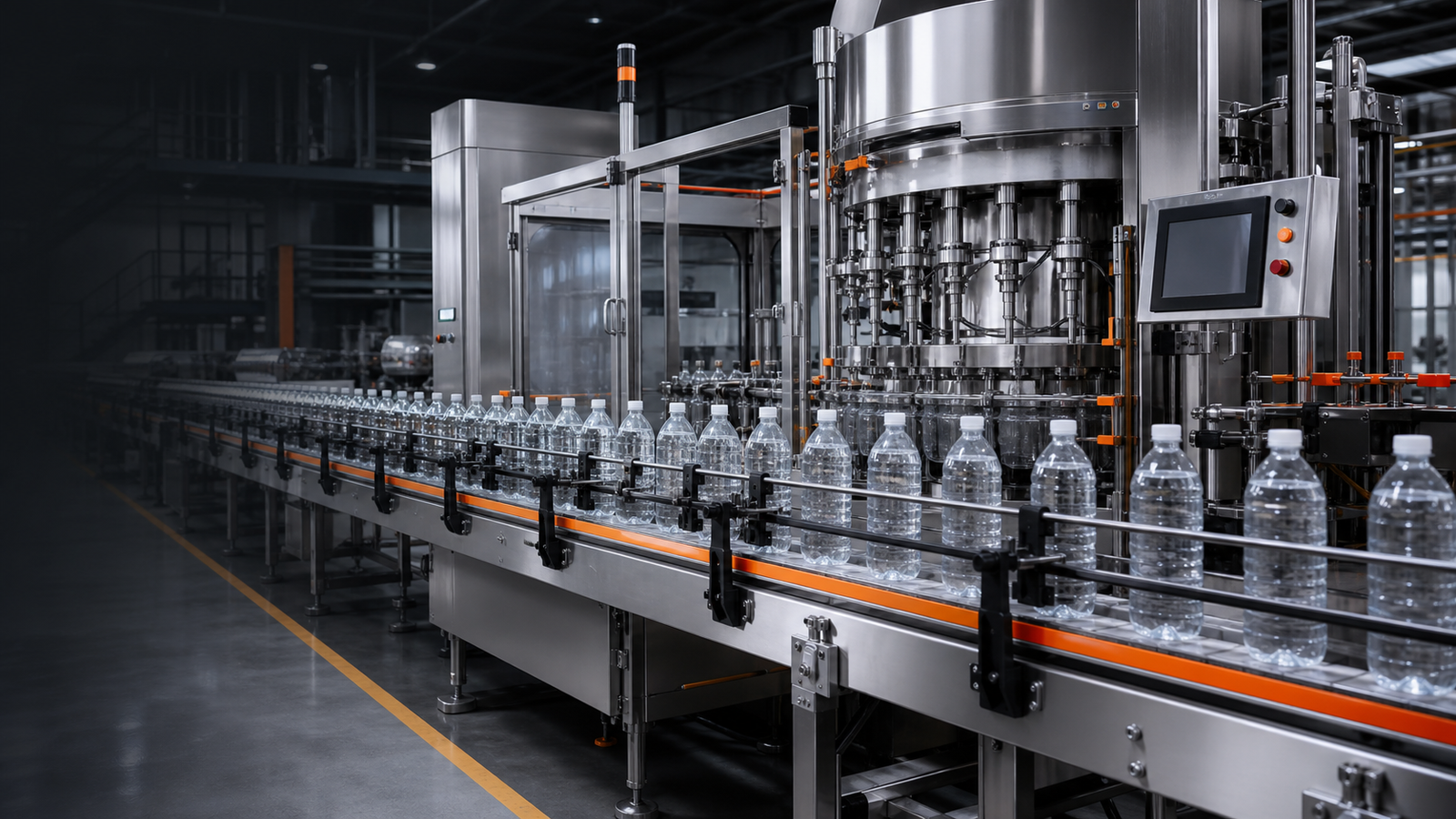
Choose the bottle-supply arrangement
A separate blow molder can feed bottles through an air conveyor or an agreed buffer arrangement. An integrated blowing and filling configuration changes transfer, hygiene and controls responsibilities. Compare both against the layout, operating schedule and ability to recover from a downstream stop.
| Arrangement | When to evaluate it | Scope to confirm |
|---|---|---|
| Semi-automatic blowing | Lower output or an early project where manual transfers are practical. | Actual operator cycle, preform heating, air supply, bottle inspection and storage. |
| Automatic standalone blower | Continuous bottle supply with space for transfer and controlled accumulation. | Preform feeding, molds, air conveyor, empty-bottle rejection and line stop/start signals. |
| Integrated blow-fill-cap configuration | Projects considering direct transfer and coordinated machine control. | Common format range, transfer responsibilities, maintenance access and recovery after a stoppage. |
| Buy finished bottles | Projects comparing capital equipment with recurring bottle freight and storage. | Delivered bottle quality, protection, receiving inspection, storage and feeding equipment. |
The least expensive blower alone may require a larger compressor package or more handling labor. Compare the installed bottle-supply system at the same accepted bottle output.
Approve bottles and preforms before releasing molds
Bottle volume does not define compatibility. Record the neck finish, body diameter, total height, base design and intended filling conditions for every launch format. A neck change may affect the preform feed, transfer parts, mold support and the filler, even when the bottle holds the same volume.
- Provide dimensioned bottle and preform drawings with revision numbers and representative samples from the intended suppliers.
- State resin and preform requirements, proposed preform weight, storage conditions and any planned recycled-content variation for supplier review.
- Distinguish still-water bottles, pressure-resistant carbonated-drink bottles and heat-resistant packages for a specified hot-fill process.
- List each mold set, neck-handling or transfer part, recipe and format-specific output separately in the quotation.
- Treat lightweighting as a package-development trial: verify distribution, top load, filling and conveying performance before accepting a lower preform weight.
Compare air and cooling at the point of use
Ask for compressed-air demand at the specified bottle, preform, cycle and operating rate. The proposal should state pressure at the machine inlet, the flow reference conditions, air quality requirements and whether recovery is included. Compressor motor power alone does not establish usable air delivery.
| Utility | Supplier information to request |
|---|---|
| High-pressure blowing air | Required inlet pressure, peak and average demand, receiver size basis, dryer/filters and measurement conditions. |
| Service air | Separate pressure, flow and quality requirements for actuators and auxiliary equipment. |
| Cooling | Heat load, supply and return temperatures, flow, water quality and connection points for each circuit. |
| Electrical supply | Connected loads, estimated operating loads at the reference format, voltage/frequency and local installation boundary. |
Confirm who supplies and installs compressors, receivers, dryers, filters, chillers and interconnecting services. Reserve access to maintain them without blocking preform or bottle movement.
Test the package and line interface together
An illustrative balance check: a filler running at 10,000 bottles per hour needs 166.7 accepted bottles per minute. A blower rated at 10,000 BPH leaves no recovery margin when bottles are rejected or the preform feed stops. The required margin must be calculated from the actual losses, buffer and control strategy; it is not a universal percentage.
- Run agreed samples for every critical format and record accepted output, rejects, operating conditions and test duration.
- Check bottle dimensions, wall distribution and the package tests agreed for the intended beverage and distribution route.
- Observe transfer to the filler, empty-bottle stability, controlled stoppage, restart and accumulation recovery.
- Record air and energy measurements with a defined boundary; distinguish blower-only demand from the complete bottle-supply system.
- Demonstrate one agreed format change, record the start and finish conditions, and hand over mold identification, settings and maintenance information.
Frequently asked questions
Can one PET blower make water and hot-fill bottles?
Only if its process, tooling and operating range are designed and verified for both packages. A bottle suitable for ambient still-water filling should not be assumed suitable for a hot-fill process.
Is the compressor included in the blower price?
Only when the quotation explicitly includes it. Require an itemized boundary for compressors, receivers, drying, filtration, cooling, piping and installation.
How should different bottle sizes be compared?
Request accepted output and utility requirements for each approved bottle and preform combination, together with the mold and change-parts list. Do not extrapolate from one reference bottle.
Prepare your equipment scope
Send the approved product and package information, required accepted output, factory conditions, destination and purchasing timeline. Mark provisional specifications clearly so that the quotation can identify assumptions and alternatives.
Planning guide from Allot Tech (Suzhou) Co., Ltd. Updated 14 September 2026.
Decide How the Line Will Receive Bottles
Compare buying finished bottles with blowing PET bottles in-house before fixing equipment scope and utilities.