 China Beverage Machinery
LanguageEnglish
Beverage factory engineering guide
Beverage Plant Water Balance Guide
Build a beverage-factory water balance covering source, treatment, product, CIP, rinsing, heating, cooling, losses, reuse and wastewater at normal and peak duty.
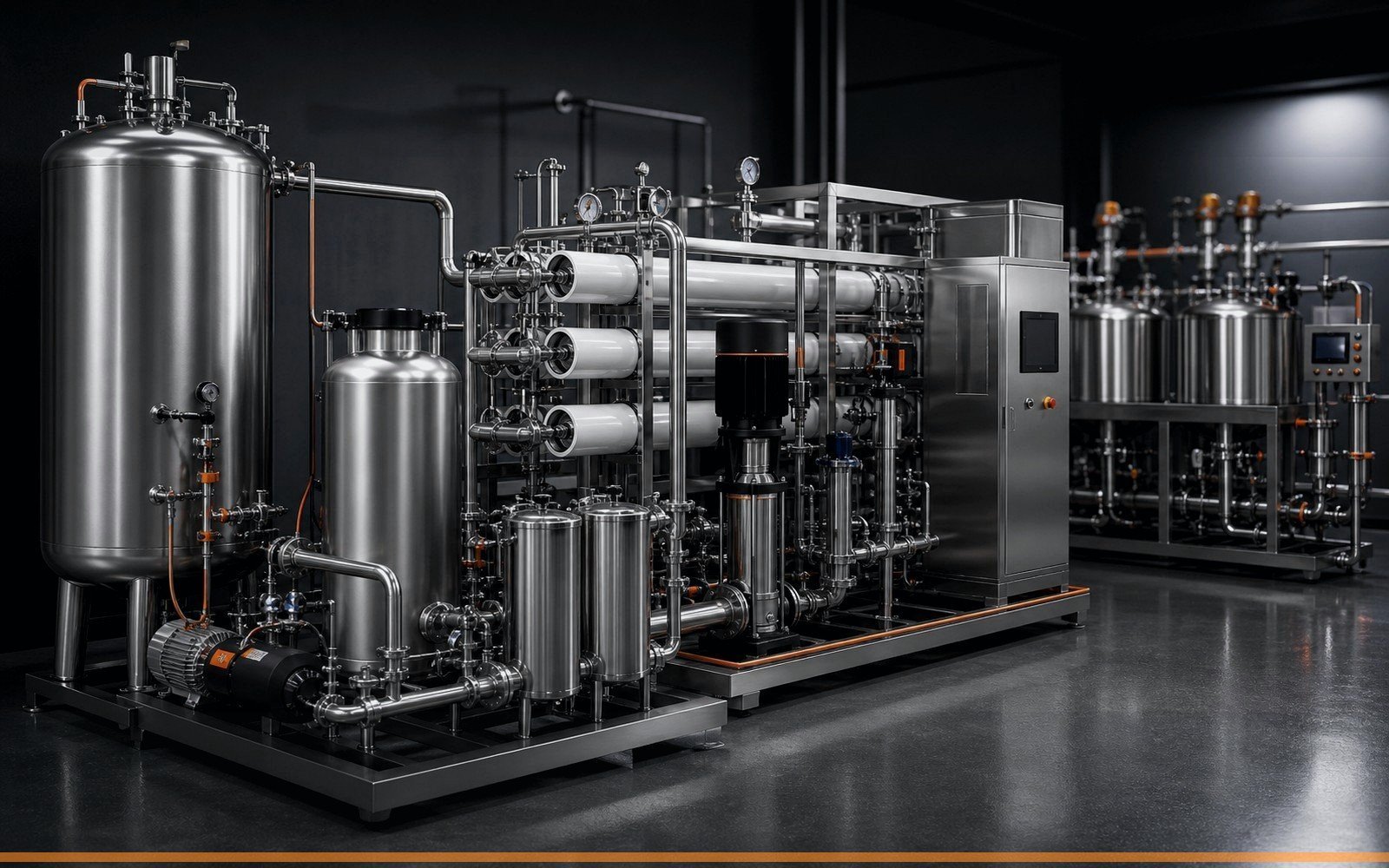
Define the engineering basis before comparing suppliers
A factory water balance connects every significant inflow, use, transfer, loss and discharge. It provides the basis for source and treatment capacity, storage, pump duty, peak distribution, boiler and cooling makeup, CIP scheduling, reuse studies, wastewater equalization and utility-cost control.
Do not multiply beverage output by one generic ratio. Create a flow diagram and schedule for each operating mode: production by product and package, startup, changeover, CIP, bottle or crate washing, maintenance, sanitation, peak season and shutdown. Distinguish measured values, supplier estimates, calculations and unresolved assumptions.
Use this page to prepare a comparable request for quotation and design review. It does not replace product validation, site-specific risk assessment, destination-market compliance, professional engineering or a signed project specification.
Six decisions that shape equipment scope and performance
Each workstream should end with an approved basis, named owner and evidence requirement. Unknowns remain visible assumptions instead of being converted into unsupported claims.
Source and treatment yield
Record source availability and variation, pretreatment backwash, membrane recovery and reject, regeneration, product-water storage, disinfection and distribution losses.
Record the confirmed input, calculation or selection basis, responsible party, required supplier response and evidence that will close this decision before purchase.
Water entering product
Calculate recipe and dilution water by SKU, batch size and production calendar, including quality grade and any separate treated-water loops.
Record the confirmed input, calculation or selection basis, responsible party, required supplier response and evidence that will close this decision before purchase.
Cleaning and rinsing
Model CIP make-up, recovery, final rinse, bottle or can rinsing, conveyor lubrication, external washing, floor cleaning and sanitation by event and simultaneous duty.
Record the confirmed input, calculation or selection basis, responsible party, required supplier response and evidence that will close this decision before purchase.
Heating and cooling systems
Include boiler feed, blowdown, condensate return, cooling-tower makeup and blowdown, chilled-water losses, pasteurizer or warmer recirculation and defrost.
Record the confirmed input, calculation or selection basis, responsible party, required supplier response and evidence that will close this decision before purchase.
Reuse and segregation
Separate streams by quality and contamination risk before considering recovery. Define treatment, storage, cross-connection prevention, monitoring and approved end use.
Record the confirmed input, calculation or selection basis, responsible party, required supplier response and evidence that will close this decision before purchase.
Metering and reconciliation
Place meters at source, major users and discharge points. Reconcile normal and peak totals, investigate the unaccounted balance and maintain a revision-controlled basis.
Record the confirmed input, calculation or selection basis, responsible party, required supplier response and evidence that will close this decision before purchase.
Make supplier responses comparable
Send the same inputs and questions to every shortlisted supplier. Require deviations, exclusions and buyer-supplied work to be stated beside the relevant line item.
| Decision area | Buyer information | Question to close |
|---|---|---|
| Inflow | Source, treatment train, yield and storage | What is available at normal and peak conditions? |
| Use | Product, cleaning, rinsing, heat and cooling | Which events overlap and determine instantaneous demand? |
| Loss or reuse | Evaporation, reject, blowdown and recoverable streams | Which flows can be measured, reduced or safely reused? |
| Discharge | Flow, temperature, pH and load by stream | Can drainage, equalization and treatment accept the peak profile? |
Resolve these gaps before procurement
A visible uncertainty can be tested, assigned or priced. A hidden assumption commonly appears later as a change order, delayed startup, failed quality check or disputed acceptance result.
- Using annual averages to size peak water supply
- Ignoring membrane reject, backwash and regeneration
- Counting recirculated water as new consumption
- Combining clean and contaminated streams before reuse review
- Omitting CIP overlap and bottle-washer discharge
- Publishing an efficiency ratio without a measured boundary
Evidence to request and retain
Documents should be revision controlled and linked to the approved project basis. Final handover should include deviations, open items, as-built status and the owner of every remaining action.
- Water flow and mass-balance diagram
- Operating-mode and production calendar
- Normal, peak and annual flow schedule
- Treatment recovery and waste-stream basis
- CIP and sanitation water schedule
- Meter list and reconciliation method
- Reuse risk assessment and cross-connection controls
- Wastewater interface and open-assumption register
Technical references for the buyer’s own review
These official industry or public-agency resources support the planning logic. They do not certify a specific project and must be interpreted against the actual product, factory and destination-market requirements.
Beverage Plant Water Balance Guide FAQ
What is a beverage plant water balance?
It is a controlled diagram and calculation that accounts for water entering, moving through and leaving every significant factory process, including product, losses and wastewater.
Should the balance use hourly or annual data?
Use both. Instantaneous and event peaks size equipment and piping; shift, monthly and annual totals support source, cost and efficiency decisions.
Can RO reject or final rinse water be reused?
Potential reuse requires stream characterization, destination-market requirements, hygienic risk assessment, suitable treatment, segregation, monitoring and approved end use.
Where should meters be installed?
At the source and major controllable users or discharge branches needed to reconcile the balance and act on abnormal consumption.
Related beverage engineering guides
Use related pages to connect this decision with product, package, process, utility, control, installation and acceptance boundaries.
Why is beverage plant water use or wastewater load higher than expected?
Reconcile water by operating mode and area instead of dividing one monthly bill by production. Treatment reject, backwash, rinsing, CIP, cooling, start-up, leaks and idle flow must be visible separately before reuse or equipment changes are proposed.
What you may be seeing
- Water use remains high when production is low
- Wastewater peaks overload drains or treatment
- RO recovery and total plant yield do not reconcile
- CIP or rinsing consumption varies by shift
Check these causes first
- Meters and calculation boundaries omit major users or losses
- Treatment reject, backwash or regeneration is not linked to production
- Rinses, overflows, leaks or open hoses continue during idle periods
- CIP and product change sequences use conservative volumes without endpoint evidence
Record before changing settings
- Meter source, treatment, process, CIP and packaging areas by time interval
- Separate production, CIP, standby and no-production baseload
- Compare normal demand with simultaneous peak demand and wastewater peak
- Reconcile source water to product, reuse, evaporation, reject and drain
Email the details needed for a technical scope review
We can organize a water-balance boundary, identify missing measurements and prepare utility, treatment, reuse and drainage questions for a factory project.
- One month of water and production data
- Water-treatment flow diagram and recovery
- CIP recipes and frequency
- Known meter locations and unmetered users
- Wastewater flow or peak-load information
Keep guards, interlocks and lockout procedures in service. Remote review can organize evidence and supplier questions, but site-specific diagnosis, food-safety validation and equipment work must be performed by competent responsible personnel.
Turn the requirement into a controlled technical RFQ
Send the product and package matrix, target saleable output, factory drawing, available utilities, destination country, budget range and purchase timeline. We can organize equipment and interface questions without inventing missing facts.